Blog

Mysteries of the Pistis Sophia, reflection 8: Showing Repentance Christ is

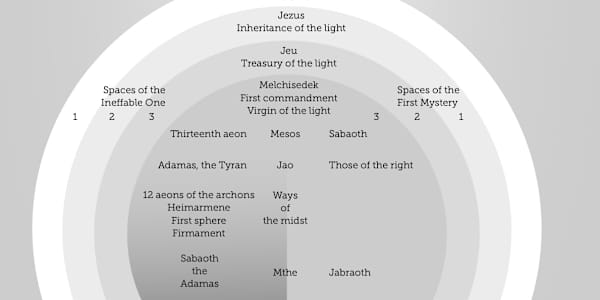
Christ is the creator of the All in the pleroma. Pistis Sophia is the guardian of wisdom in the cosmic order within the All. Consequently, the light-humanity in the pleroma has the wisdom—that is, Sophia—of the Ineffable at its disposal as a power. When a part of humanity begins to live outside the pleroma, Sophia guides this humanity into the realm of life that then develops: the thirteenth aeon. Here Christ reveals Himself as the first mystery.

In the first book of the Gospel of the Pistis...

Mysteries of the Pistis Sophia, reflection 7: Controlling the astral fire

Suppose a soul has reached the point of reincarnating anew. It is in a virginal state, like a blank slate. The workers of the Order of Melchizedek guide this soul through this very delicate process of incarnation. In doing so, the soul is brought into a body and will learn, step by step, to express itself in a body of flesh and blood.

At the moment of incarnation, the soul is connected to an information field in which the essence of all previous incarnations is stored. The soul thus has a...

Mysteries of the Pistis Sophia, reflection 6: understanding the cosmic

When we look at the sky on a clear night, we are like a speck of dust compared to the expanse of stars and planets. If we look through a large telescope, the Earth, too, becomes a speck of dust in a seemingly infinite universe. Seen in space and time, we are nothing. Who are we, then, to contemplate the cosmos beyond what is perceptible to the senses?

There are many myths that were once put on paper to remind man of what he is in danger of forgetting, but which he needs in order to discover...

Mysteries of the Pistis Sophia, reflection 5: The wheel of birth and death

We are all born with our own unique destiny, and we cannot help but follow the path that destiny directs. Great powers guide our destiny because we are born from the Heimarmene. Here the archons rule. These Archons follow the laws of planets, which follow their orbits relative to the fixed stars. They bind these forces to humanity through what the Gospel of Pistis Sophia calls: the false spirit.

The false spirit thus keeps us bound to the fate we received at birth. It propels our lives along...

Mysteries of the Pistis Sophia, reflection 4: getting to know and recognize

What is our true intention regarding life? Are we focused on the light that has descended into our hearts, to surrender itself within our being, to give our lives a turn toward a different realm of life?

We may struggle with that question. We may experience the light from the depths of our being, but we may get distracted and forget about it from time to time. Perhaps we sometimes become impatient, wanting to know exactly how we are doing and whether liberation is imminent. Or we may want to...

Mysteries of the Pistis Sophia, reflection 3, approaching the mysteries

Mysteries of the Pistis Sophia, reflection 3, approaching the mysteries

There is a luminous reality in the pleroma where the creator, the Ineffable, can directly reveal himself to Adam of light, as the ancients called this humanity. They also spoke of the pre-existent Christ, who is eternally existent, in contrast to our reality, which is defined by the experience of space and time.

Humanity that turns away from the pleroma loses its garments of light, as many of the Nag Hammadi scriptures...

Mysteries of the Pistis Sophia, reflection 2, conducting the dialogue When

When people gather based on their inner resolve to learn the mysteries, a power appears to help them. This is the mythical image depicted when Jesus stands with his disciples on the Mount of Olives. Jesus' power has already connected with the life-field of the earth, but in the disciples, this power finds people who not only believe, but also act. For the deeds of the disciples activate all the powers of the redeemer in the life-field of space and time.

Thus, at the beginning of the Gospel...

Mysteries of the Pistis Sophia, reflection 1, clarifying the context I've

I've often heard it: why should I delve into an ancient text or an old book? I have to live my life here and now, in the twenty-first century; that's where it has to happen. I follow a spiritual path with the possibilities of modern times; an old book can't help with that. Why would I put so much effort into understanding something as incomprehensible as the text we know as the Gospel of the Pistis Sophia?
On the other hand, we could say: I don't care how much effort it takes to find the...